
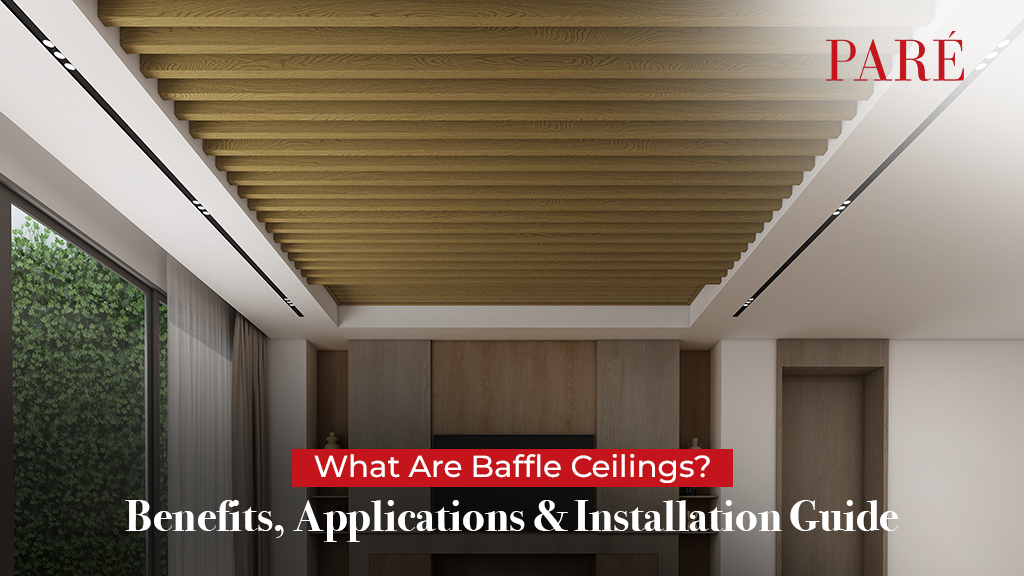
Currently, in contemporary architectural practice, both acoustic well-being and the sense of spatial dimension are increasingly vital aspects of building performance. Pare India provides ceiling systems that we manufacture, which integrate
- Noise reduction
- Air distribution
- Exact construction
A baffle ceiling is created with hanging, straight components which both enhance sound deadening, and also form a ceiling appearance that is striking to look at.
Unlike ceilings which are level, baffle systems permit sound to travel amongst the upright parts, lessening reverberation and making spoken communication more easily understood. As a result, they are well suited to business, educational and busy public spaces.
What Are Baffle Systems and How Do They Work?
Baffle systems consist of suspended vertical or horizontal linear panels arranged at uniform spacing. These elements are typically installed using suspension grids or customised mounting tracks. The open structure allows sound waves to be absorbed while maintaining airflow circulation above the ceiling plane.
In many design applications, these systems are also extended as baffle wall solutions where acoustic control and architectural detailing must be integrated into vertical surfaces. This creates continuity between ceiling and wall acoustic treatments.
Benefits of Baffle Ceiling Systems
From an engineering perspective, these systems deliver measurable performance improvements. Properly designed installations contribute to acoustic balance, thermal airflow management and long term structural stability.
Key benefits include:
- Improved sound absorption and noise control
- Enhanced airflow circulation above ceiling cavities
- Modern architectural appearance with linear depth
- Easy service accessibility for lighting and HVAC
- Reduced visual bulk compared to solid ceilings
These advantages make them suitable for offices, airports, educational institutions and retail environments.
How Pare India Scores Over Competitors Technically
At Pare India, we focus on manufacturing precision, acoustic efficiency and structural consistency. Compared with generic acoustic panel manufacturers, we engineer controlled panel density and uniform perforation to improve sound absorption performance.
Our systems are designed for long term dimensional stability, ensuring that alignment remains consistent even in temperature variable environments. Many imported alternatives prioritise visual uniformity but may lack installation flexibility for Indian project conditions.
Within acoustic linear ceiling categories such as R50-S BAFFLE CEILING, performance depends heavily on core material composition and suspension stability. We ensure calibrated thickness tolerance and consistent acoustic backing compatibility.
Additionally, when compared with traditional gypsum acoustic ceilings, baffle systems provide superior airflow movement and easier service accessibility. Gypsum solutions provide sound absorption but restrict airflow and increase service access complexity.
Additional Comparison with Metal Linear Ceilings
Metal linear ceilings are sometimes considered alternatives for visual linear design. While they provide durability and fire resistance, they often require specialised installation and can produce sound reflection rather than absorption unless combined with acoustic backing. In contrast, engineered baffle systems naturally support acoustic diffusion while maintaining structural flexibility.
Installation Overview and Structural Integration
Installation requires accurate suspension alignment, spacing calibration and load distribution planning. During installation, both Baffle Top and Baffle Bottom alignment must be maintained to ensure visual uniformity and acoustic efficiency. Proper spacing ensures balanced sound absorption and airflow movement.
Installation also allows integration with lighting systems, sensors and HVAC outlets without disturbing the ceiling layout.
Product Spotlight – Pare India Acoustic Baffle System
Product Name: Baffle R50-S (Acoustic Enhancing Exterior Wall Panels)
Product Code: 52
Sizing: 3060x50x50
Available Shades: 8 Shades
This system is engineered for acoustic enhancement while maintaining exterior grade durability. The panel geometry is optimised for sound diffusion and architectural linear aesthetics. The controlled manufacturing ensures uniform profile accuracy, which is critical for large ceiling spans.
Applications Across Modern Spaces
Ceiling systems of this type are very common in business offices, airports, large meeting halls, hotels and schools. They offer good sound quality, and allow for up-to-date building design.
When a Baffle ceiling is being chosen, we at all times look at the desired sound levels, the gap between the units, how much weight the fixings will need to bear, and what is needed to get it to fit in with the rest of the building.
Long Term Value and Performance
Baffle systems offer a balance between acoustic engineering and architectural flexibility. Their open structure allows easy maintenance access while maintaining performance efficiency. With proper installation and specification, they deliver long lifecycle performance with minimal maintenance.
At Pare India, we design baffle systems that combine acoustic science, structural reliability and visual precision for modern building requirements.
Contact Pare India to specify advanced acoustic baffle ceiling systems engineered for performance and durability.

